


for all
But, it is much more than that.
From these grounds, we hope that future geshemas (Buddhist female scholars having undergone the academic training and rigour of at least a PhD in Buddhist philosophy) will emerge, forming the future epicenter of Buddhist learning for females.
From these grounds, we hope to share with everyone how we have applied our learning in practical ways, how our lives have changed for the better. And we hope that others can do so too.
A monastery for all.
of Events
Architectural Features
For the Buddhist nun, a brightly-lit pathway symbolizes the practitioner’s path to enlightenment.
Each step -
Filled with dedication and good intentions
Each step -
Closer to self-realization
Closer to full wisdom and compassion.
1. What will the monastery campus look like? What does a Buddhist monastery consist of?
Currently, GWBI expects its monastery campus to be as shown in the below (image for visualization purposes only and subject to change).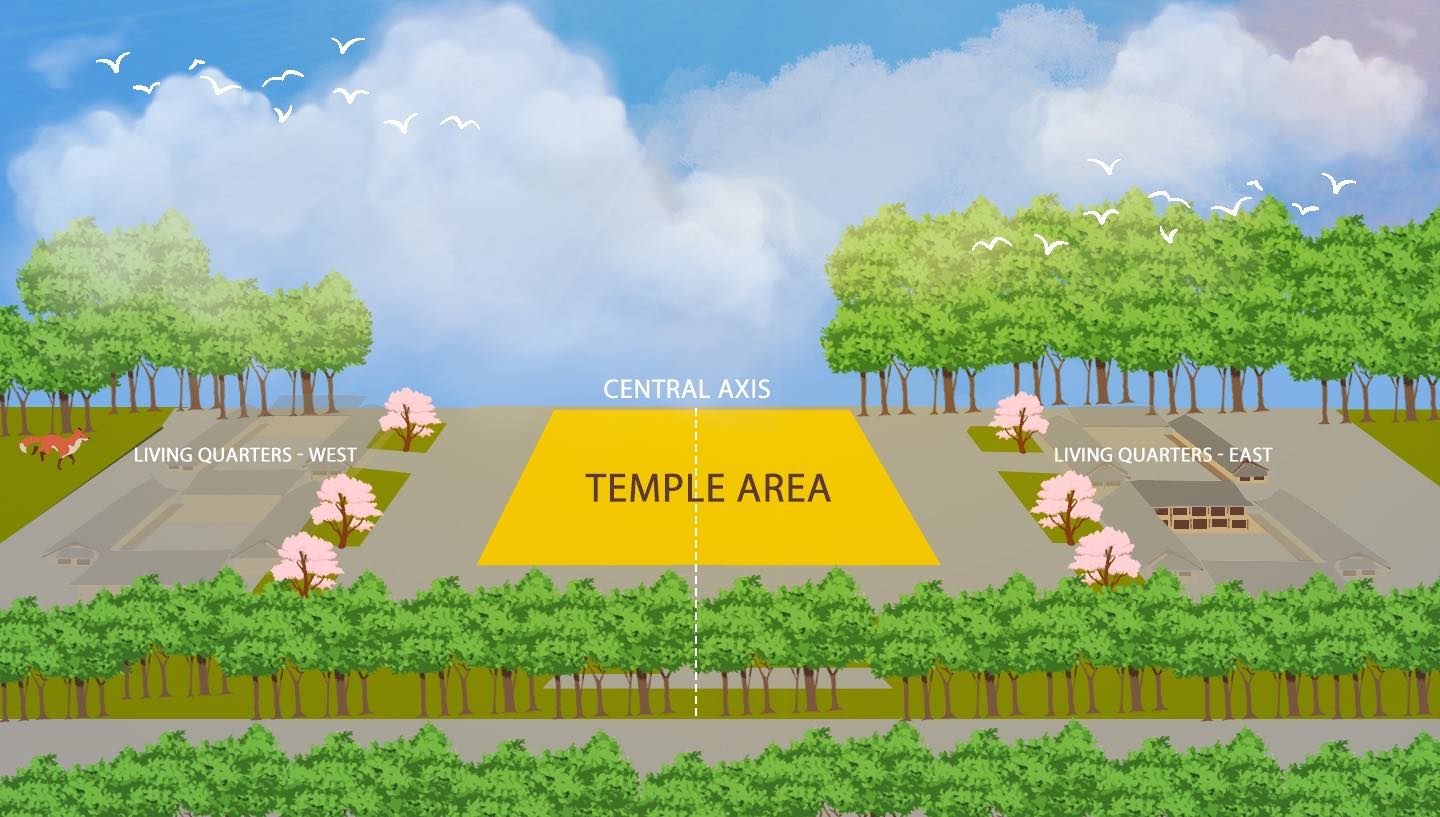
Typically a Buddhist monastery consists of a prayer hall, dining hall, living quarters, and classrooms.
2. What are your next steps?
Since 2012, nuns have continuously enrolled in our prestigious 16-year Buddhist curriculum, dedicating their lives to studying and preserving Tibetan Buddhism. Not many people in the world choose this path. As such, we would like to support every individual who does by building a campus for their study and practice.
Our current priority is to complete the construction of living quarters on the east side, as well as its supporting infrastructure, to provide living space for the students and nuns continually being enrolled. We currently plan to have seven main buildings on the east side, of which two have already been built. The progress of our construction is contingent on building permit approvals and sufficient funds being raised.
3. How many nuns will stay at your North Lotus campus?
The maximum capacity of North Lotus is expected to be 1,400. With new nuns and students enrolling each year, we expect to reach capacity in 20 years or more.
4. How do you support locals through your construction?
We hired Nine Yards Studio, a local architect and WM&M (1993), a local general contractor to work on our monastery construction. As we hope to support the local community, we asked WM&M (1993) to hire local Eastern PEI workers as much as possible. In addition, most of our construction materials are sourced locally.
5. Is it true that your monastery campus will be a gated enclave? Do you plan to build a hospital, police station etc. in your campus?
Similar to a post-secondary education campus, we have students living on our monastery grounds. Security measures, such as a boom gate for check-in purposes, are in place to protect their personal safety. These measures are similar to those at UPEI and Holland College. Over the years, we have experienced several security incidents involving trespassing individuals, some of whom were intoxicated. Infractions include breaking into, stealing, as well as vandalizing property. We were fortunate to have security measures in place to minimize the damage and impact.
As Buddhist nuns, upholding our monastic precepts, some of which involve codes of conduct when interacting with the opposite gender, is a critical part of our practice. Our security measures, which include receiving visitors during a specified time frame also help us uphold our precepts.
GWBI welcomes visitors who would like to learn more about us. We would be happy to schedule visits with those who are interested.
There will NOT be a hospital, police station, fire station nor secret tunnels on the GWBI campus.
6. Does GWBI pay property taxes?
Yes. Per provincial regulations, Great Wisdom Buddhist Institute pays property taxes at an institutional rate (higher than the residential rate), 1.5% based on taxable assessed value. Only the prayer hall in Uigg is tax exempt. All other buildings and land in Brudenell and Uigg are taxed (as per Real Property Tax Section 3.1.a.).